Monitoring coke levels during the delayed coking process is critical to helping operators maintain control of the coking cycle and avoid issues such as foam-over. But when it comes to choosing or replacing a coke drum monitoring system, there are several questions that come up time and again.
With the launch of DrumVision™, Tracerco’s neutron backscatter instrument for coke drum monitoring, we’ve been having more conversations with operators about the technology, its practical application and what is involved in replacing legacy systems.
Here are three of the questions we’re most frequently asked.
1. Why choose neutron backscatter over gamma?
Not all coke drum measurement technologies provide the same information.
Gamma transmission systems measure the attenuation of gamma radiation as it passes through the drum. This can provide continuous indication of the overall level, however distinguishing between different phases within the drum can be challenging.
Neutron backscatter works differently. Fast neutrons interact with hydrogen atoms in the material in front of the detector, with a proportion of the neutrons being scattered back towards the detector. Because hydrogen density varies between phases such as vapour, foam, water and coke, changes in the backscattered neutron signal can provide information about what is present at the measurement point.
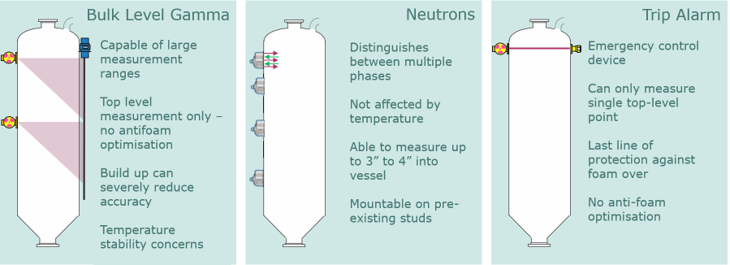
This can be particularly useful when operators need to identify the transition between foam and coke, or distinguish wet from dry coke.
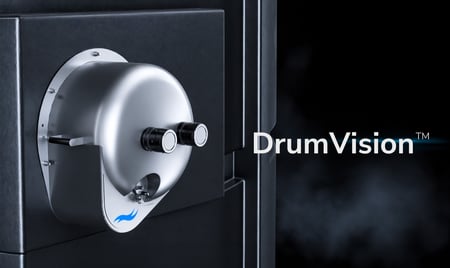
This is one of the key principles behind DrumVision™. Rather than simply indicating that material has reached a particular level, its neutron backscatter technology is designed to help operators identify changes in the material present at critical measurement points.
2. Can a neutron backscatter system be retrofitted without a major shutdown?
Replacing an existing coke drum monitoring system can raise an obvious concern: how much disruption will it cause to the operation?
DrumVision™ has been designed with retrofit applications in mind, including replacement of legacy neutron backscatter systems. Where existing mounting studs are suitable, the instrument can be installed using the existing mounting arrangement, helping to simplify the replacement process.
The requirement for a shutdown will depend on the existing installation. Where suitable mounting studs are already in place, installation may not require a shutdown. Where new studs are required, a shutdown may be necessary to complete the modifications.
For operators with ageing or obsolete neutron backscatter equipment, this can provide a practical route to upgrading the measurement system without necessarily requiring significant modifications to the coke drum.
3. How often does the system need to be calibrated?
Calibration is another important consideration when selecting a coke drum monitoring system, particularly for operators looking for a reliable solution that does not require frequent intervention.
DrumVision™ uses a solid scintillator detector rather than the gas-filled detector technology used in some legacy neutron backscatter systems. The detector incorporates electronic compensation for temperature changes, helping maintain the neutron measurement within the required operating range.
During commissioning, the system is calibrated against the expected hydrogen density conditions and the measurements observed during the initial coking cycle. Once the system has been established and calibrated, it is designed to provide stable measurements without the need for routine recalibration of the measurement points.
Modernising coke drum monitoring
The questions customers ask about coke drum monitoring often come down to three things: what can the technology tell me, how difficult is it to install, and how much ongoing intervention does it require?
These are exactly the considerations that have helped shape the development of DrumVision™.
By combining neutron backscatter technology with a retrofit-ready design and scintillation detector, DrumVision™ is designed to provide operators with a modern approach to coke drum monitoring, while helping address some of the challenges associated with aging legacy systems.
Find out more about DrumVision™ and how Tracerco can support your coke drum monitoring. Download our fact sheet, case study, recently published whitepaper or watch our webinar, where our experts explain about DrumVision™ and its benefits.

Have questions concerning this article? Complete the form below this blog for more details.