Monitoring the changing conditions inside a delayed coke drum is an important part of managing the coking cycle. As material moves through different phases, operators need reliable information at critical points within the drum to help monitor coke formation and identify conditions that could lead to foam-over.
There are several technologies available for coke drum monitoring, including gamma transmission and neutron backscatter. While both use radiation-based measurement, they work in fundamentally different ways and provide different types of information.
So, what is the difference and why does it matter?
How does gamma transmission work?
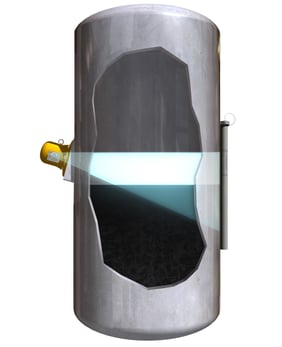 A gamma transmission system typically uses a radioactive source positioned on one side of the coke drum and a detector positioned on the opposite side.
Gamma radiation passes through the material contained within the drum before reaching the detector. As the radiation travels through the drum, some of it is absorbed or scattered. The amount of radiation reaching the detector therefore changes according to the material and overall density in the beam path.
By monitoring these changes, gamma transmission can provide a continuous indication of the overall level across a vertical measurement range.
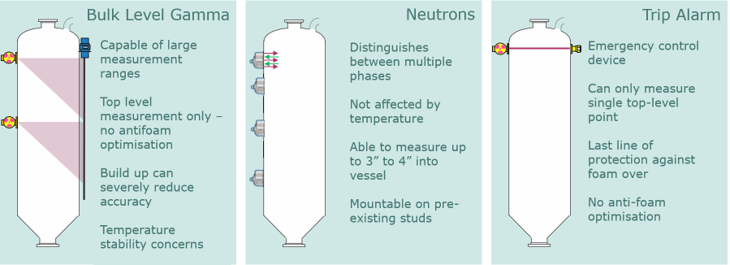
This makes gamma technology useful for tracking changes in the overall level within a coke drum. However, because the measurement is based on the attenuation of radiation across the entire path between the source and detector, interpreting the signal can be more challenging when different phases are present.
For example, foam and coke can produce different conditions within the drum, but the measurement does not directly identify the phase responsible for a change in signal.
How does neutron backscatter work?
Neutron backscatter takes a different approach.
Instead of measuring radiation transmitted through the entire drum, the instrument emits fast neutrons towards the material immediately in front of the detector. When these neutrons interact with hydrogen atoms, some are scattered back towards the detector as lower energy neutrons.
The amount of backscattered neutron radiation is influenced by the hydrogen density of the material being measured.
This is significant in a coke drum because the hydrogen density changes as the material changes. Vapour, foam, coke and water can therefore produce different neutron responses.
Rather than simply asking “has the level reached this point?”, neutron backscatter can provide information that helps indicate “what is present at this point?”
Why does hydrogen density matter?
The difference in measurement principle becomes particularly relevant when monitoring the transition between phases within the coke drum.
As the coking cycle progresses, the conditions at a particular elevation can change from vapour to foam and then to coke. The characteristics of the material in front of the detector change with it.
Because neutron backscatter is sensitive to hydrogen density, changes in the neutron signal can help identify these transitions.
This can be particularly useful when monitoring the foam-to-coke interface or when identifying differences between wet and dry coke.
For operators, this additional information can help provide greater visibility of what is happening at critical elevations within the drum, rather than relying solely on an indication of overall level.
Neutron backscatter vs gamma: a different measurement approach
The key distinction is therefore not simply that one technology is “better” than the other. It is that they measure different properties and can therefore be suited to different monitoring requirements.
Gamma transmission measures the attenuation of gamma radiation through the material across the measurement path. It can provide continuous level information over a large vertical span.
Neutron backscatter measures the neutrons scattered back from material close to the detector, with the response influenced by hydrogen density. This makes it particularly useful where distinguishing between different phases at specific measurement points is important.
For coke drum applications, that distinction can be valuable.
How does DrumVision™ use neutron backscatter
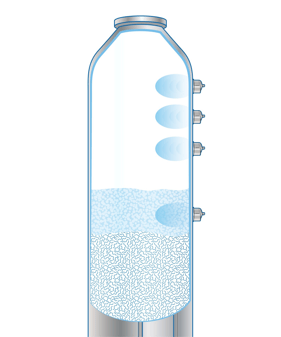
Tracerco developed DrumVision™ specifically for delayed coke drum monitoring, using neutron backscatter technology to provide fixed-level measurement at critical elevations.
The system is designed to identify changes in hydrogen density and therefore provide information on the material present in front of the detector. This can help operators monitor important transitions within the coking cycle, including the foam-to-coke interface and changes associated with wet and dry coke.
DrumVision™ also has a retrofit-ready design, supporting replacement of legacy neutron backscatter systems where suitable existing mounting arrangements are available.
Choosing the right measurement technology
The most appropriate coke drum monitoring technology depends on what the operator needs to know.
Where the primary requirement is continuous indication of overall level across a large vertical range, gamma transmission can provide an effective measurement approach.
Where the ability to distinguish changes between phases at critical elevations is important, neutron backscatter offers a different set of capabilities.
Understanding that distinction is key when evaluating coke drum monitoring systems particularly, as operators consider replacing ageing or obsolete neutron backscatter equipment.
With DrumVision™, Tracerco is bringing a modern neutron backscatter solution to the coke drum market, combining established measurement principles with a new detector and instrument design.
Find out more about DrumVision™ and how neutron backscatter can provide insight into coke drum operation. Download our fact sheet, case study, recently published whitepaper or watch our webinar, where our experts explain about DrumVision™ and its benefits.

Have questions concerning this article? Complete the form below this blog for more details.