Knowing where coke is forming and how the level is progressing inside a delayed coker is an important part of managing the coking cycle.
As the drum fills, the contents change through different phases, including vapour, foam and coke. Operators therefore need measurement technology that can provide reliable information at the points that matter.
But how is coke level actually measured in a delayed coker?
What is a delayed coker?

Delayed coking is a thermal cracking process used in refineries to convert heavy residual feedstocks into lighter hydrocarbon products and solid petroleum coke.
The process takes place in large coke drums. Hot feed enters the drum and undergoes further thermal cracking, with coke gradually building up inside the vessel.
As the coking cycle progresses, the conditions inside the drum change. The level of material rises and different phases can be present at different elevations.
Monitoring these changes helps operators manage the process and determine when the drum is approaching its required operating level.
Measuring level inside a coke drum
Measuring level inside a coke drum presents some particular challenges.
The vessel operates at high temperatures and contains changing mixtures of vapour, liquid, foam and solid coke. Conventional level measurement technologies may therefore not be suitable for the conditions or may provide limited information about the different phases present.
Radiation-based technologies can provide a non-contact approach to measurement, which is particularly useful for applications where installing conventional instrumentation inside the vessel is impractical.
Two technologies that have been used for coke drum monitoring are gamma transmission and neutron backscatter.
Gamma transmission
Gamma transmission systems use a radioactive source positioned on one side of the coke drum and a detector on the opposite side.
Gamma radiation passes through the drum, and the detector measures the radiation that reaches it. As the material within the measurement path changes, so does the amount of radiation received by the detector.
This can provide an indication of changes in the overall level and can be used to monitor level across a significant vertical span.
However, the measurement represents the material across the entire path between the source and detector. This can make it more difficult to determine which phase is responsible for a change in the measurement.
Neutron backscatter
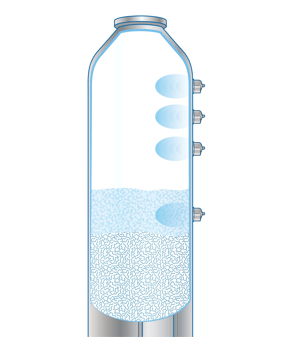
Neutron backscatter takes a different approach.
Fast neutrons are emitted towards the material in front of the detector. When they interact with hydrogen atoms, some of the neutrons are scattered back towards the detector.
The resulting signal is influenced by the hydrogen density of the material being measured.
This is particularly relevant in a coke drum because hydrogen density changes between phases such as vapour, foam, coke and water.
As a result, neutron backscatter can provide information about the material present at a specific measurement point, rather than simply indicating that material has reached a particular level.
Why does the measurement approach matter?
For some applications, knowing the overall level is the primary requirement.
For others, it is important to understand what is happening at a particular elevation.
This distinction is particularly important when operators need to monitor the foam-to-coke interface or identify changes associated with wet and dry coke.
By placing neutron backscatter instruments at critical elevations, operators can monitor changes in the material at those points as the coking cycle progresses.
How DrumVision™ measures phases in coke drums
DrumVision™ uses neutron backscatter technology to provide fixed-level measurement at critical points on a coke drum.
Fast neutrons interact with hydrogen-containing material in front of the instrument, and the resulting backscatter is measured by the detector. Changes in the response can indicate changes in the material present at the measurement point.
This provides operators with information that can complement conventional level measurement and help provide greater insight into the changing conditions inside the drum.
The system is designed for non-contact measurement, with the instrument installed externally on the coke drum.
From measuring level to understanding what is happening
Coke drum monitoring is not simply about knowing how high the material has reached.
Understanding the conditions at critical elevations can provide additional information to help operators manage the coking cycle and monitor the transition between different phases.
The measurement technology therefore needs to be considered alongside what the operator actually needs to know.
For applications where distinguishing changes between phases is important, neutron backscatter provides a different approach to conventional level measurement.
Find out more about DrumVision™ and how neutron backscatter can provide insight into coke drum operation. Download our fact sheet, case study, recently published whitepaper or watch our webinar, where our experts explain about DrumVision™ and its benefits.

Have questions concerning this article? Complete the form below this blog for more details.