Inside a delayed coker, the transition between foam and coke is more than simply a change in material. Knowing where that transition occurs can be important when managing the coking cycle and protecting the operation from unwanted events such as foam-over.
This is one of the reasons understanding the foam-to-coke interface is an important consideration when selecting coke drum monitoring technology.
What is the foam-to-coke interface?
During the coking cycle, hot feed enters the coke drum and thermal cracking produces solid coke alongside lighter hydrocarbon vapours and other material.
As coke builds within the drum, a layer of foam can form above the coke bed. The position of the interface between the foam and the underlying coke changes as the coking cycle progresses.
The exact conditions within the drum can vary depending on the process and operating conditions, but the interface represents an important transition between phases.
Why is the interface important?
A conventional level measurement can tell an operator that material has reached a particular elevation. But in a coke drum, that may not tell the whole story.
Knowing whether a measurement point is seeing vapour, foam or coke can provide additional context about what is happening inside the vessel.
This becomes particularly important as the coke bed rises and the foam layer approaches critical elevations.
If foam reaches areas where it is not expected, there is potential for foam-over, where foam can carry over into downstream equipment. Monitoring the conditions within the drum can therefore form an important part of managing the coking cycle.
Why can the interface be difficult to measure?
The challenge is that the material inside the drum is not static.
As the cycle progresses, the material at a particular elevation can change from vapour to foam and eventually to coke. The measurement system therefore needs to respond to changing material properties rather than simply detecting the presence or absence of material.
This is where the underlying measurement principle becomes important.
Gamma transmission measures the attenuation of radiation across the path between a source and detector. It can provide useful information about changes in overall density and level, but distinguishing between phases can be challenging.
Neutron backscatter works differently.
Because the measurement is influenced by hydrogen density in the material close to the detector, changes in the neutron response can provide information about changes in the phase present at a particular measurement point.
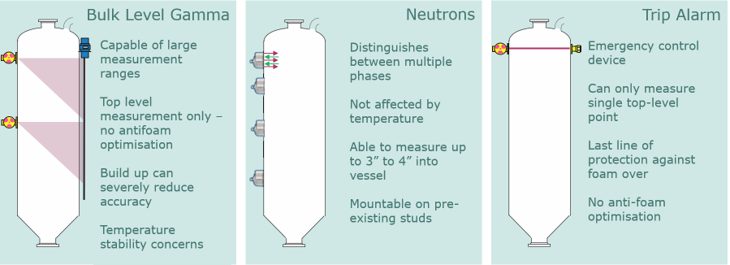
Using neutron backscatter to monitor the interface
Neutron backscatter can be particularly useful for applications where operators need to identify the transition between foam and coke.
As the material in front of the detector changes, the hydrogen-density characteristics also change. This produces a corresponding change in the backscattered neutron signal.
By positioning detectors at critical elevations, the system can therefore provide information about when the foam-to-coke interface reaches those points.
This is a different approach to simply measuring the overall level of the drum.
How DrumVision™ supports foam-to-coke monitoring
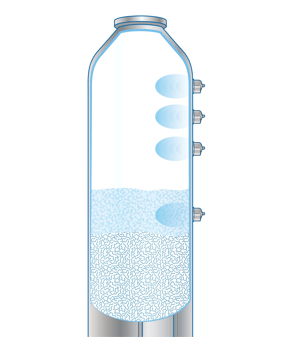
DrumVision™ uses neutron backscatter technology to provide fixed-level measurement at critical elevations within the coke drum.
The system is designed to detect changes in hydrogen density and provide information about the material present at the measurement point. This can help operators monitor the foam-to-coke interface as it moves through the drum during the coking cycle.
The same measurement principle can also provide information that helps distinguish between wet and dry coke, adding further insight into conditions within the drum.
Supporting better-informed operations
The foam-to-coke interface is just one part of the complex environment inside a delayed coker. However, understanding where that interface is and how it is changing can provide useful information when managing the coking cycle.
For operators, the value is not simply knowing that the level has risen. It is having greater insight into what is present at critical elevations and how conditions are changing over time.
That is where neutron backscatter can offer a valuable measurement approach.
Find out more about DrumVision™ and how neutron backscatter can provide greater insight into foam-to-coke interface monitoring. Download our fact sheet, case study, recently published whitepaper or watch our webinar, where our experts explain about DrumVision™ and its benefits.

Have questions concerning this article? Complete the form below this blog for more details.